Liver Fibrosis Risk Assessment
Beyond Fatty Liver Detection: A GenAI Framework for Liver Fibrosis Risk Assessment Using FibroScan and Blood Reports
By Suresh Madhra · Community contribution
Beyond Fatty Liver Detection: A GenAI Framework for Liver Fibrosis Risk Assessment Using FibroScan and Blood Reports
A proposed approach using Amazon Bedrock, Retrieval-Augmented Generation (RAG), and evidence-grounded clinical reasoning
Abstract
Fatty liver disease can progress to liver inflammation, fibrosis, cirrhosis, and other serious complications. However, detecting fat accumulation in the liver is not the same as determining whether significant liver fibrosis is present.
FibroScan, also known as vibration-controlled transient elastography (VCTE), provides measurements of liver stiffness and the Controlled Attenuation Parameter (CAP). Blood tests provide additional information about liver enzymes, platelet count, and metabolic health. Interpreting these measurements together can be challenging, particularly when results from multiple dates need to be compared.
This paper proposes a Generative AI framework that combines FibroScan reports, laboratory results, and authoritative clinical guidance using Amazon Bedrock and Retrieval-Augmented Generation (RAG).
Rather than training a conventional machine-learning model to predict liver disease, the proposed solution uses deterministic calculations for established clinical scores, retrieves relevant medical evidence, and employs a foundation model to generate a structured, explainable assessment.
The objective is to investigate whether this approach can help organize clinical evidence, identify potentially concerning patterns, highlight inconsistencies, and support the prioritization of patients for professional evaluation.
Keywords: Generative AI, Amazon Bedrock, RAG, FibroScan, liver fibrosis, MASLD, healthcare AI, clinical decision support.
1. Introduction
An interesting question in healthcare AI is:
If medical diagnostics already provides laboratory values and FibroScan measurements, what additional value can Generative AI deliver?
Simply extracting numbers from a medical report and summarizing them does not create substantial clinical value. The real opportunity lies in interpreting multiple sources of information together, explaining their significance, and identifying situations that may warrant closer clinical attention.
For example, a FibroScan report may contain:
- Liver stiffness measurement, expressed in kilopascals (kPa).
- Controlled Attenuation Parameter (CAP), expressed in dB/m.
- Measurement-quality information.
- The reporting clinician's interpretation.
A blood report may contain:
- Aspartate aminotransferase (AST).
- Alanine aminotransferase (ALT).
- Platelet count.
- Gamma-glutamyl transferase (GGT).
- Glucose or HbA1c.
- Lipid measurements.
Each result provides a different piece of information.
FibroScan liver stiffness helps assess the likelihood of liver fibrosis, whereas CAP estimates liver fat. Blood-based scores, such as FIB-4, provide additional information about fibrosis risk. These measures are complementary rather than interchangeable.
Clinical guidance from the American Association for the Study of Liver Diseases (AASLD) describes sequential assessment using blood-based scores and additional non-invasive tests when indicated.
Reference: AASLD — Noninvasive Liver Disease Assessment.
This creates an opportunity to investigate a different application of GenAI: combining the available evidence into a coherent, traceable assessment rather than merely reporting individual measurements.
2. The Problem Statement
The proposed research addresses the following question:
Can a GenAI-based system combine FibroScan measurements, blood-test results, and clinical guidelines to support the identification of patterns associated with clinically significant liver fibrosis?
The solution should investigate five capabilities:
- Interpret liver stiffness and CAP separately.
- Calculate established clinical scores using validated formulas.
- Compare available findings with relevant clinical guidance.
- Identify missing information, potentially conflicting results, and changes over time.
- Produce a structured explanation with traceable evidence for review by a healthcare professional.
The objective is not to replace FibroScan, diagnose cirrhosis autonomously, or replace a hepatologist. It is to investigate whether GenAI can improve the way existing clinical information is integrated and communicated.
3. Why Use GenAI Instead of Training a New ML Model?
A conventional supervised machine-learning model typically requires a dataset containing patient features and appropriately defined outcome labels. It learns statistical relationships between those inputs and outcomes.
That approach is appropriate when the objective is to predict an outcome, such as future disease progression, from historical patient data.
However, our initial research question is different.
We already have measured FibroScan values and blood-test results. We want to interpret those measurements using established clinical evidence.
A GenAI-based architecture can support this workflow without pretending that an LLM has learned a clinically validated probability of disease.
The proposed division of responsibilities is:
| Component | Responsibility | |---|---| | Data extraction | Read relevant values from reports | | Python validation | Check units, missing values, dates, and data consistency | | Clinical calculation engine | Calculate established scores such as FIB-4 | | Amazon Bedrock Knowledge Base | Retrieve relevant clinical guidance | | Foundation model | Explain the evidence and identify uncertainties | | Application layer | Present results, sources, and limitations |
This separation is important. Numerical calculations and threshold comparisons should be performed by validated code or explicitly defined clinical rules, not left to unconstrained LLM reasoning.
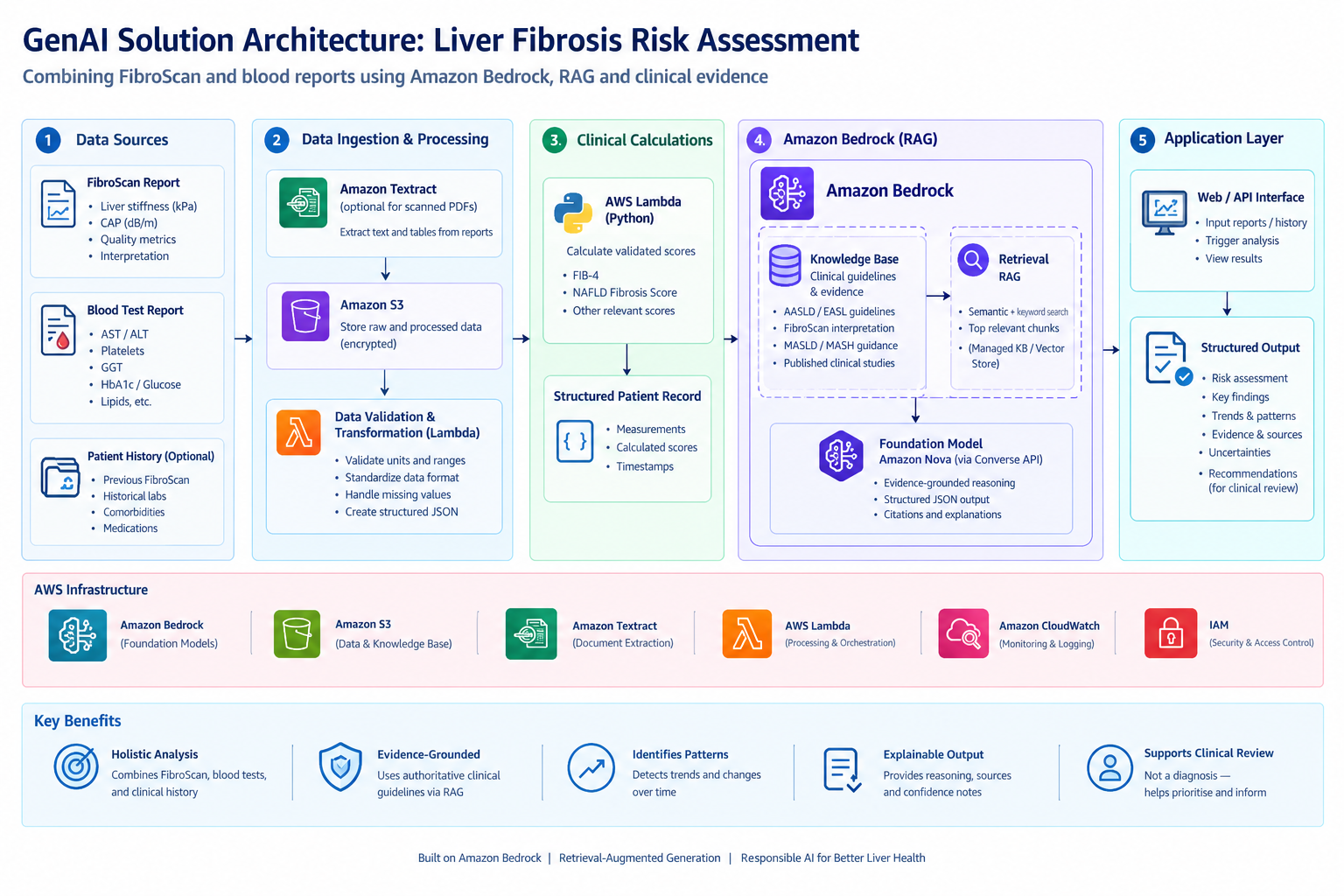
4. Proposed Architecture
The proposed system uses Amazon Bedrock as the GenAI platform.
4.1 Data extraction
The first component extracts the relevant measurements from the available reports.
For digitally generated PDFs, text extraction may be sufficient. Scanned reports may require OCR, such as Amazon Textract, subject to compatibility and privacy requirements.
The extracted values should be normalized into a common structure.
Example:
{
  "patient_reference": "DEMO-001",
  "report_date": "2026-01-15",
  "fibroscan": {
    "liver_stiffness_kpa": 9.2,
    "cap_dbm": 318,
    "quality_metrics_available": false
  },
  "blood_tests": {
    "ast": 42,
    "alt": 51,
    "platelets": 185,
    "hba1c": 6.4
  }
}
These are illustrative values, not actual patient results. Units, laboratory reference ranges, measurement dates, and missing values must be preserved in the implementation.
4.2 Clinical calculations
The next component calculates established clinical scores where the necessary data are available.
For example, FIB-4 uses age, AST, ALT, and platelet count:
\[ \mathrm{FIB\text{-}4} = \frac{\mathrm{Age}\times\mathrm{AST}} {\mathrm{Platelets}\times\sqrt{\mathrm{ALT}}} \]
The formula assumes the conventional units for these laboratory measurements.
The score should be calculated in Python and validated against an independently verified implementation. Age-specific considerations and clinical applicability must also be addressed.
The system should not infer a missing platelet count or substitute an unavailable value without explicitly flagging the limitation.
4.3 Retrieval-Augmented Generation
The RAG component retrieves relevant material from a controlled knowledge base containing appropriately licensed clinical guidance and supporting references.
Potential source categories include:
- AASLD guidance on non-invasive liver disease assessment.
- European Association for the Study of the Liver (EASL) guidance on non-invasive tests.
- Published evidence about transient elastography and blood-based fibrosis scores.
The retrieved evidence should include source details and enough surrounding context to support interpretation.
RAG does not make the underlying evidence automatically correct. The source documents, versions, retrieval quality, and applicability to the patient population must be reviewed.
4.4 Amazon Bedrock interpretation
The foundation model receives a structured patient record, calculated scores, relevant clinical evidence, and explicit output requirements.
Its task is to explain the available evidence, not independently invent diagnostic thresholds.
For example, it may be asked to distinguish between:
- Findings relating to liver fat.
- Findings relating to liver stiffness and fibrosis risk.
- Blood-test abnormalities that require context.
- Missing information that limits interpretation.
- Results that appear inconsistent and need professional review.
The generated output should cite the retrieved sources and distinguish measured facts from interpretations.
5. Example Python Implementation
The following prototype demonstrates how to calculate FIB-4 and invoke an Amazon Bedrock model. It is an architectural starting point, not a clinically validated application.
Step 1: Calculate FIB-4
This code illustrates the calculation only. The example values are hypothetical, and the resulting score is not a diagnosis.
Step 2: Retrieve clinical evidence
Assume that a Bedrock Knowledge Base has already been created and populated with reviewed clinical documents.
The retrieval configuration must match the actual Knowledge Base type and supported AWS API configuration. For managed Knowledge Bases, use the configuration required by that deployment.
Step 3: Ask Bedrock to generate an evidence-grounded assessment
For production use, add JSON-schema validation, error handling, source verification, access controls, and appropriate logging. A model response that looks like valid JSON is not necessarily clinically correct.
6. The More Interesting Capability: Longitudinal Analysis
The greatest opportunity may emerge when multiple reports are available over time.
A single FibroScan provides a measurement at a particular point. Multiple measurements can help clinicians examine changes, provided that differences in measurement conditions and technical reliability are considered.
Consider this hypothetical dataset:
| Year | Liver stiffness | |---|---:| | 2023 | 6.8 kPa | | 2024 | 7.5 kPa | | 2025 | 8.6 kPa | | 2026 | 9.2 kPa |
A simple program can calculate the change between measurements. GenAI can then help explain why the pattern merits review, using relevant clinical evidence.
However, an increase in liver stiffness does not automatically prove that fibrosis has progressed. Liver stiffness may also be affected by inflammation, cholestasis, venous congestion, food intake, and other factors.
Reference: EASL guidance on non-invasive tests.
The system should therefore describe an observed trend and its limitations, rather than automatically labeling it disease progression.
An advanced version could correlate longitudinal FibroScan measurements with changes in AST, ALT, platelet count, HbA1c, and other relevant variables. It could flag patterns for review without claiming to establish causation.
7. Evaluation Strategy
A credible research project must evaluate the system rather than assume that a plausible explanation is a correct one.
The proposed evaluation should cover four dimensions.
Clinical interpretation
- Are established scores calculated correctly?
- Are the cited thresholds appropriate for the intended population?
- Does the system distinguish steatosis from fibrosis?
- Does it correctly represent uncertainty and missing data?
Retrieval quality
- Does the knowledge base retrieve the appropriate guidance?
- Are source citations accurate?
- Does it retrieve outdated or conflicting recommendations?
Generation quality
- Does the answer stay within the retrieved evidence?
- Does it avoid unsupported diagnostic conclusions?
- Does it distinguish measurements from generated interpretations?
Clinical usefulness
- Does the system help reviewers identify missing information?
- Does it improve consistency in report interpretation?
- Does it reduce time spent assembling evidence?
- Does it flag concerning or discordant findings without excessive false alarms?
Clinical usefulness must ultimately be assessed by qualified reviewers using a defined evaluation protocol.
If the future objective is to predict advanced fibrosis or future disease progression, that requires a separate study with suitable labeled data, an explicit outcome definition, independent validation, and performance measures such as sensitivity, specificity, calibration, and AUROC.
No such performance results are claimed in this proposal.
8. Limitations and Responsible Use
Several limitations must be addressed before this architecture can be used in clinical practice.
First, GenAI can generate plausible but incorrect explanations. Retrieval improves access to evidence but does not eliminate hallucinations.
Second, liver stiffness and CAP measurements have different purposes. CAP relates to steatosis, while liver stiffness helps assess fibrosis risk. Neither should be treated as a universal stand-alone indicator of overall liver health.
Third, interpretation depends on the clinical context, including the underlying cause of liver disease, measurement quality, laboratory units, and patient characteristics.
Fourth, the application must protect sensitive health information. A production implementation requires appropriate AWS permissions, encryption, access controls, retention policies, auditability, and compliance with applicable healthcare privacy requirements.
Finally, this proposed system is a research prototype. It must not be used to diagnose patients, rule out serious disease, or determine treatment without appropriate clinical validation and oversight.
9. Conclusion
This paper proposes a GenAI-based framework that combines FibroScan measurements, blood-test results, clinical calculations, and retrieved medical evidence using Amazon Bedrock.
The central idea is not to ask an LLM to replace an existing diagnostic test. It is to investigate whether a carefully designed GenAI system can integrate existing results, explain their meaning, highlight uncertainty, and support more consistent clinical review.
The next research stage is to implement the prototype, assemble a de-identified dataset with appropriate permissions, obtain expert-reviewed reference interpretations, and evaluate the system systematically.
The broader principle is simple: healthcare AI should add value beyond extracting information or repeating an existing diagnosis. It should be evaluated on whether it improves evidence integration, risk communication, and the quality of decisions made by qualified professionals.
References
- American Association for the Study of Liver Diseases (AASLD). Noninvasive Liver Disease Assessment.
- American Association for the Study of Liver Diseases (AASLD). Practice Guidance on the Clinical Assessment and Management of Nonalcoholic Fatty Liver Disease.
- European Association for the Study of the Liver (EASL). Clinical Practice Guidelines on Non-invasive Tests for Evaluation of Liver Disease Severity and Prognosis.
- Amazon Web Services. Amazon Bedrock Documentation.
Research status: Proposed architecture and implementation methodology. Experimental validation and clinical evaluation remain future work.